Our Threads.
Every FÅGELBO holds a little world of textile art.
Each piece is one-of-one, imagined and finished by a single maker.
This is why every FÅGELBO is numbered.
Fine Cotton Tapestry
Ramses Wissa Wassef Art Center · Harraniya, Egypt
Founded in 1951 by architect Ramses Wissa Wassef and his wife Sophie, an art teacher, the Art Center began as a weaving school for children and young people from the surrounding villages, organised as a cooperative.
Ramses worried that traditional crafts in Egypt were disappearing. His approach was unusual—especially for the time—because of how little he wanted to impose. He believed creativity grows best when it’s protected from pressure and outside influence.
Students learned the loom, then worked from imagination—without copying patterns, and without criticism or grading. The focus was the process, and the confidence that comes from making at one’s own pace.
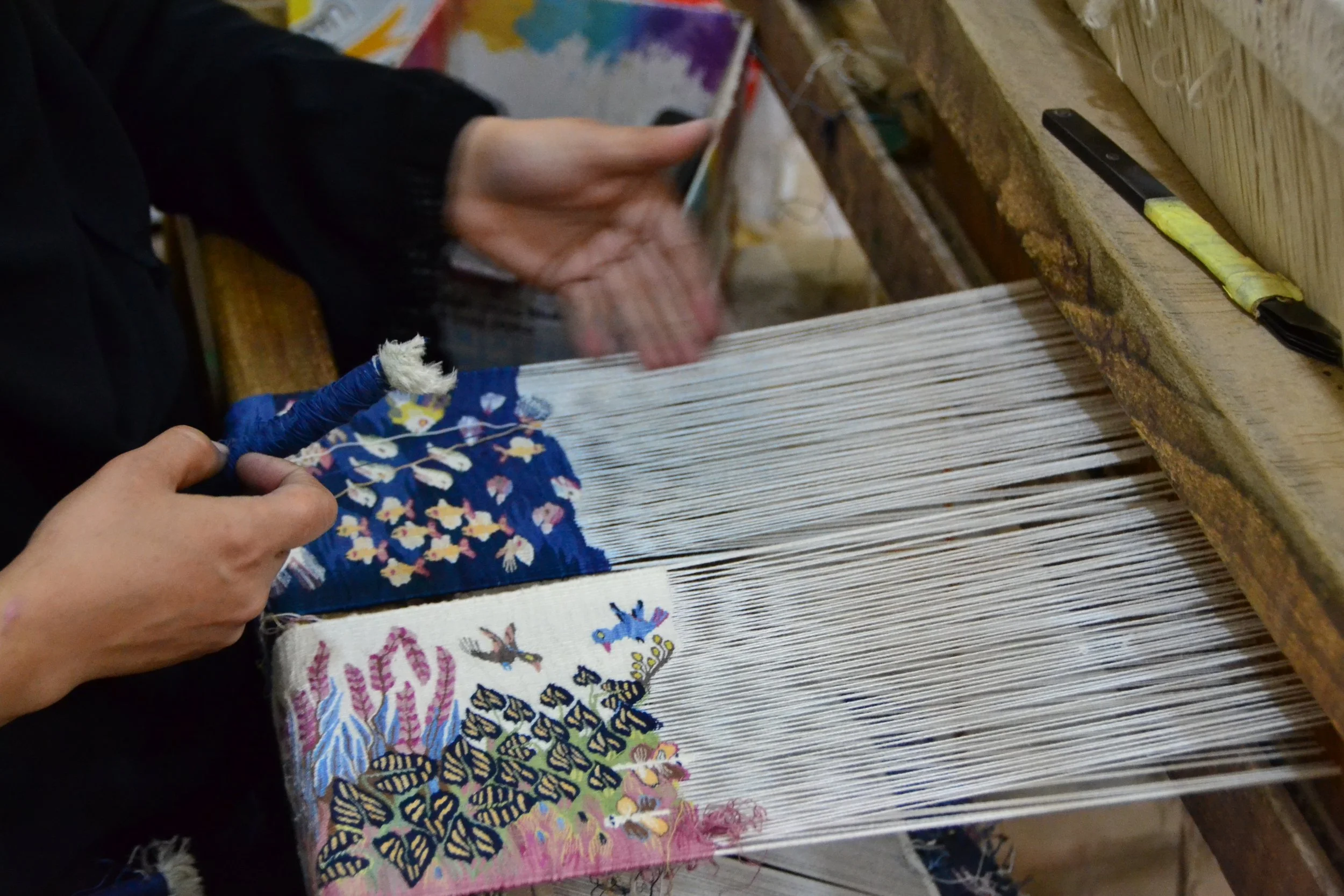
The woven works from this tradition are made slowly, thread by thread. Every change of colour has to be controlled by hand, and mistakes can’t easily be undone. It takes years—often decades—to weave with that kind of freedom: choosing colour well, keeping the tension steady, and building detail until the scene feels right.
Embroidery
Embroidery is stitched by hand with needle and thread. A motif is often transferred to the cloth first—commonly by tracing/transfer methods—so the embroiderer can work with accuracy. The fabric is usually held taut in a hoop or frame for control.
What makes embroidery special is the detail it can build without a loom: fine lines, dense colour, and subtle texture. It also demands control—especially tension. Stitches pulled too tight can pucker the cloth; too loose and the work loses definition.
Across the Middle East, embroidery has long been used on clothing and household textiles. In Palestinian tatreez, embroidered patterns traditionally signalled regional identity; in Syria, motifs and colours have also been used to distinguish local and regional styles—and in northern Iraq, festive garments like the charuga from Qaraqosh are known for their own distinctive embroidered pattern tradition.


Living Threads
Like birds building their nests, our artists work thread by thread. No two pieces can ever be the same — each FÅGELBO is a mark of its distinctive world carried in thread and leather.